

Sustainability · 2025
In this section52 topics
- Sustainability Policy3 items
- Sustainability Goals & UN SDGs3 items
- Policy Review3 items
- Business Value Chain1 item
- Stakeholder Analysis2 items
- Environmental Policy & Guidelines4 items
- Environmental Policy Review1 item
- Energy — Plan & Guidelines3 items
- Energy — Electricity Consumption1 item
- Energy — Fuel Consumption1 item
- Energy — Targets2 items
- Energy — Performance & Outcomes2 items
- Water — Plan & Guidelines3 items
- Water — Withdrawal, Discharge & Consumption1 item
- Water — Targets2 items
- Water — Performance & Outcomes2 items
- Waste — Plan & Guidelines3 items
- Waste — Generation, Disposal & Recycling1 item
- Waste — Targets2 items
- Waste — Performance & Outcomes2 items
- GHG — Plan & Guidelines3 items
- GHG — Emissions1 item
- GHG — Emissions Verification3 items
- GHG — Principles & Standards1 item
- GHG — Targets1 item
- GHG Targets — Net Zero1 item
- GHG Targets — Other Targets1 item
- GHG — Performance & Outcomes2 items
- Environmental Legal Incidents1 item
- Other Environmental Management1 item
- Social Sustainability — Overview1 item
- Social Policy & Guidelines4 items
- Social Policy Review1 item
- Social — Principles & Standards Practised1 item
- Human Rights Due Diligence4 items
- Employees — Plan & Guidelines4 items
- Employees — Workforce2 items
- Employees — Remuneration & Provident Fund1 item
- Employees — Training & Development1 item
- Employees — Occupational Health & Safety1 item
- Employees — Labour Relations1 item
- Employees — Employee Representation2 items
- Employees — Targets2 items
- Employees — Performance & Outcomes2 items
- Customers — Plan & Guidelines3 items
- Customers — Satisfaction Results1 item
- Customers — Targets2 items
- Customers — Performance & Outcomes2 items
- Community & Social — Plan & Guidelines3 items
- Community & Social — Targets1 item
- Community & Social — Performance & Outcomes2 items
- Law Violation Incidents1 item
Sustainability Policy
Has a Sustainability Policy
Yes
Policy Description
Sustainability remains at the heart of Thai Union’s purpose and long-term strategy. Since the launch of SeaChange in 2016, the company has worked to redefine what responsible seafood leadership looks like, driving improvements in human rights, ocean stewardship, climate action, and community well-being across its global value chain. In 2025, Thai Union continued this journey by advancing SeaChange 2030, its strengthened sustainability framework designed to accelerate progress during a decade of intensifying environmental and social challenges.
SeaChange 2030 sets out a clear path for delivering meaningful outcomes for both people and the planet. Built around 11 interconnected goals, the strategy aligns with and contributes to 10 of the United Nations Sustainable Development Goals. It positions Thai Union to respond decisively to the realities of climate change, the need for resilient ecosystems, and the growing expectations of customers, regulators, and communities.
The strategy is founded on five objectives organized under two themes: For Our People and For Our Planet. For Our People, Thai Union is dedicated to promoting safe, fair, and ethical employment across its operations and supply chains, while also supporting the health, nutrition, and economic well-being of communities reliant on the seafood industry. For Our Planet, the company maintains a strong commitment to substantial emissions reductions across all scopes, fosters circularity through improved waste and resource management, and safeguards biodiversity by implementing validated best practices and targeted restoration efforts.
Together, these commitments reinforce Thai Union’s belief that long-term success is inseparable from responsible business practices. As the company works toward its 2030 vision, it continues to invest in solutions that strengthen ocean health, support thriving communities, and deliver value for stakeholders across the global seafood system.
Policy Document Link
https://www.thaiunion.com/en/sustainability/policy
Sustainability Goals & UN SDGs
Has Sustainability Goals
Yes
Goals Description
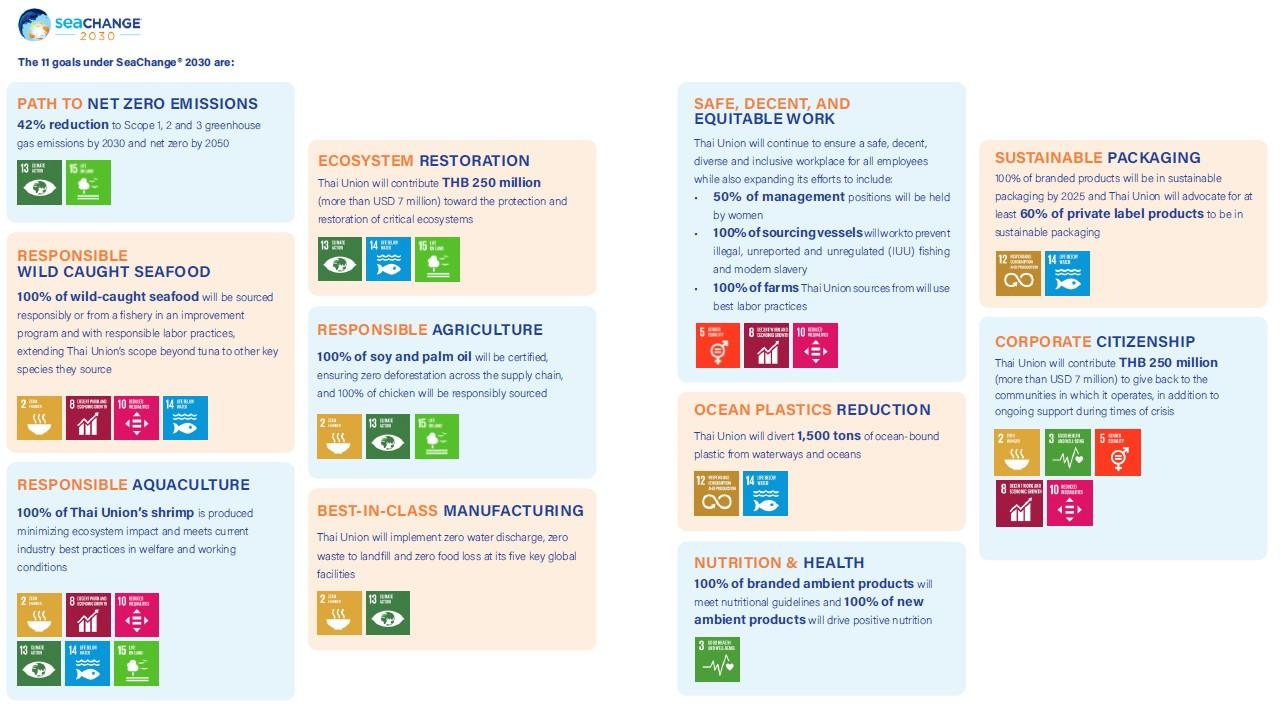
UN Sustainable Development Goals
| SDG Goal |
|---|
| Goal 2 Zero Hunger |
| Goal 3 Good Health and Well-being |
| Goal 5 Gender Equality |
| Goal 8 Decent Work and Economic Growth |
| Goal 10 Reduce Inequalities |
| Goal 12 Responsible Consumption and Production |
| Goal 13 Climate Action |
| Goal 14 Life below Water |
| Goal 15 Life on Land |
Policy Review
Policy Reviewed This Year
Yes
Policy Changed This Year
Yes
Review Details
1. Review of the Company’s sustainability performance in the past year. The committee received updates on progress toward the SeaChange 2030 commitments.
2. Strategic refinements to the SeaChange 2030 framework to enhance clarity, measurability, and long-term impact.
Business Value Chain
Value Chain Description
Impact Management to stakeholders in the Business Value Chain
Business Value Chain
Thai Union Group’s business value chain encompasses a comprehensive and sustainable approach to seafood production and distribution. It begins with responsible sourcing of raw materials, including wild-caught and farmed seafood, ensuring adherence to stringent environmental and ethical standards. The company’s processing operations transform these materials into high-quality products, leveraging innovative technologies and strict quality controls. Thai Union’s extensive distribution network delivers products to global markets, supporting major retail, food service, and private-label brands. The value chain is reinforced by the company's commitment to sustainability through initiatives like SeaChange, emphasizing transparency, traceability, and the well-being of marine ecosystems and workers throughout the supply chain.
Stakeholder Analysis
Introduction
Stakeholder Analysis and Engagement
The company implemented Stakeholder Analysis in accordance with AA1000 Stakeholder Engagement Standard (AA1000SES) with three key principles of stakeholder inclusivity, materiality, and responsiveness. Each business unit is responsible for stakeholder analysis in relevant areas to its operation. The results will be gathered and reanalyzed at the organizational level under the supervision of the Sustainability Committee. Methods of communication and engagement vary according to each group of stakeholders, as detailed below
Stakeholder Analysis
| Stakeholder Type | Stakeholders | Stakeholder Expectations | Response to Expectations | Communication Activities |
|---|---|---|---|---|
| External stakeholders | 2904 · Description: Investors or investment institutions | - Business growth and performance
- Good governance
- Business Transparency of information
- Opportunity and risk management
- Social and environmental responsibilities
| - Transparency and governance (anti-corruption, data disclosure, tax policy and reporting)
- Investor Relations Communications team, quarterly face-to-face investor updates with sustainability briefing
- Climate change and environmental protection
| 2944 · Description: Annual General Meeting (AGM) · 2949 · Other name: Quarterly Analyst Meeting · Description: Others · 2949 · Other name: Investor roadshow · Description: Others · 2949 · Other name: Opportunity day organized by the Stock Exchange of Thailand · Description: Others |
| External stakeholders | 2899 · Description: Suppliers | - Certifications
- Consistency expectation
- Increasing orders
- Future opportunity to work with Company
| - Responsible sourcing
- Vessel Code of Conduct
- Supplier audits and capacity building
| 2949 · Other name: Regular meetings with suppliers · Description: Others · 2949 · Other name: Global Channels email: Labor.CoC@thaiunon.com · Description: Others |
| External stakeholders | 2923 · Description: Customers | - Product quality (health and nutrition) and price
- Social and environmental impact from the use of products
- Eco-labelling (e.g., MSC, dolphin safe, ASC, BAP, carbon footprint of products)
| - Innovation and product responsibility (quality, food safety)
- Increased customer communication and face-to-face or virtual meetings on sustainability held globally
- Offering more sustainable alternatives to meet customer demand
- Responsible sourcing
- Climate change and environmental protection
- Updates on our Tuna Commitment 2025 and SeaChange 2030 goals
| 2949 · Other name: Customer satisfaction survey · Description: Others · 2949 · Other name: Regular meetings with customers · Description: Others · 2949 · Other name: Whistleblower channel · Description: Others |
| External stakeholders | 2915 · Description: Consumers | - Eco labelling
- Competitive pricing
- Food safety
- Product quality (health and nutrition)
- Social and environmental responsibilities
- Eco labelling (e.g., MSC, Dolphin safe,
ASC, BAP, carbon footprint of products)
| - Innovation and product responsibility (quality, food safety)
- Responsible sourcing
- Can trackers and traceability data as well as product information
| 2949 · Other name: Customer satisfaction survey · Description: Others · 2949 · Other name: Whistleblower channel · Description: Others |
| Internal stakeholders | 2921 · Description: Employees | - Fair compensation and benefits
- Fair labor practices
- Safety and wellness
- Career development and opportunity
- Work-life balance
- Diversity & Inclusion
| - Channels for employees to submit opinions and their complaints
- Human rights and fair labor practices
- Human capital development
- Management program
- Global program of harmonization of work standards
- Brand ambassador program and Thai Union Global rollout
- Development of JEDI Champions
| 2949 · Other name: Town Hall · Description: Others · 2949 · Other name: Employee engagement survey · Description: Others · 2949 · Other name: Speak Out platform (Whistleblower channel) · Description: Others · 2949 · Other name: Breaches reporting channels · Description: Others · 2949 · Other name: Thailand Telephone: +66 (0) 3481-6500 Fax: +66 (0) 3481-6499 · Description: Others · 2949 · Other name: Confidential Email: labor.CoC@thaiunion.com · Description: Others · 2949 · Other name: Project ISSARA · Description: Others · 2949 · Other name: Myanmar language: +66-80-456-5560 · Description: Others · 2949 · Other name: Lao and Thai language: +66-86-967-2891 · Description: Others · 2949 · Other name: Khmer language: +66-86-968-6085 · Description: Others |
| Internal stakeholders | 2936 · Other name: Daily/ Migrant workers · Description: Others | - Fair compensation and benefits
- Fair labor practices
- Safety and wellness
- Ethical Recruitment
| - Ethical Recruitment Policy and Employer Pays Principle (EPP)
- Human rights and fair labor practices
- Human capital development
| 2949 · Other name: Safety talk · Description: Others · 2949 · Other name: Town Hall · Description: Others · 2949 · Other name: Employee engagement survey · Description: Others · 2949 · Other name: Speak Out platform (Whistleblower channel) · Description: Others · 2949 · Other name: Worker Welfare Committees · Description: Others · 2949 · Other name: Breaches reporting channels. · Description: Others · 2949 · Other name: Thailand Telephone: +66 (0) 3481-6500 Fax: +66 (0) 3481-6499 · Description: Others · 2949 · Other name: Confidential Email: labor.CoC@thaiunion.com · Description: Others · 2949 · Other name: Project ISSARA · Description: Others · 2949 · Other name: Myanmar language: +66-80-456-5560 · Description: Others · 2949 · Other name: Lao and Thai language: +66-86-967-2891 · Description: Others · 2949 · Other name: Khmer language: +66-86-968-6085 · Description: Others |
| External stakeholders | 2902 · Description: Community | - Legal compliance
- Social and environmental responsibilities
- Partnership in community development
- Socioeconomic development
| - Transparency and governance (anti-corruption, data disclosure, tax policy and reporting)
- Nutritional information
- Communities
| 2949 · Other name: Whistleblower channel · Description: Others · 2949 · Other name: Communication through community development officers · Description: Others |
| External stakeholders | 2936 · Other name: Government · Description: Others | - Legal compliance
- Participation in government programs
| - Transparency and governance (anti-corruption, data disclosure, tax policy and reporting)
- Responsible Sourcing
| 2949 · Other name: Visit on various occasions · Description: Others · 2949 · Other name: Participation and promotion of activities organized by the government sector · Description: Others · 2949 · Other name: Response to requests for data disclosure · Description: Others |
| External stakeholders | 2936 · Other name: NGOs · Description: Others | - Social and environmental responsibilities
- Marine conservation
- Participation in social and environmental programs
- Transparency of information
| - SeaChange 2030 Goals
- 56-1 One report
- Transparency and governance (anti-corruption, data disclosure, tax policy and reporting)
- Reports & Updates
| 2949 · Other name: Response to requests for data disclosure · Description: Others · 2949 · Other name: Fact sheet summary · Description: Others |
| External stakeholders | 2936 · Other name: International organizations · Description: Others | - Regulatory compliance
- Transparency of information
- Social and environmental responsibilities
- Transparency of information
| - Transparency and governance (anti-corruption, data disclosure, tax policy and reporting)
- Joint workshops such as with the ILO Communities
| 2949 · Other name: Visit on various occasions · Description: Others · 2949 · Other name: Participation and promotion of activities organized by the international organizations · Description: Others · 2949 · Other name: Response to requests for data disclosure · Description: Others |
| External stakeholders | 2936 · Other name: Academia · Description: Others | - Social and environmental responsibilities
- Marine conservation
- Participation in social and environmental programs
| - Climate change and environmental protection
- Communities
- Collaboration with Stockholm Resilience Centre through SeaBOS
- Collaboration with University of Sydney
| 2949 · Other name: SeaBOS Keystone Dialogue meeting · Description: Others · 2949 · Other name: GIC project collaboration · Description: Others |
| External stakeholders | 2936 · Other name: Media · Description: Others | - Transparency of information
- Timeliness of information
| - Transparency and governance (anti-corruption, data disclosure, tax policy and reporting)
- Engagement on material issues
| 2949 · Other name: Publishing information on the website · Description: Others · 2949 · Other name: Media activities and events · Description: Others |
Environmental Policy & Guidelines
Has an Environmental Policy
Yes
Policy Description
SAFETY, HEALTH AND ENVIRONMENT POLICY Culture: we will systematically integrate SHE considerations into every business decision to make a real positive improvement towards a safe workplace, the community and the environment. This includes empowering ou remployees and stakeholders to recognize the SHE impacts of their work activities and the impact of the Company’s mitigation initiatives via effective competency training, communication, and assurance.
Compliance: we will be fully accountable for compliance with applicable SHE legislations, customer requirements, an dappropriate international standards and guidelines.
Captivation of perspectives and consultation with stakeholders: we shall capture the viewpoints and experience of our employees, contractors, customers, suppliers, communities, and other stakeholders, as we believe the best SHE strategy, priorities and practices incorporate a broad range of perspectives. Continual Improvement: Our measurable SHE targets always reflect our ambition to be the seafood industry’s leading agent of change. We shall continually monitor and review our SHE performance against the targets set as well as benchmark ourselves with stakeholders’ expectations and industry best practices for continual SHE performance improvement. This policy applies to all Thai Union operations, including our subsidiaries. All employees, particularly management, shall demonstrate leadership and be accountable for policy alignment. All employees and contractors under Thai Union’s supervision are obligated to understand and ensure compliance with this policy throughout all work activities.
Policy Document Link
https://www.thaiunion.com/en/sustainability/policy
Environmental Guidelines
| Guideline |
|---|
| Electricity Management |
| Fuel Management |
| Renewable/Clean Energy Management |
| Water Management |
| Waste Management |
| Biodiversity Management |
| Greenhouse Gas and Climate Change Management |
Environmental Policy Review
Policy Reviewed This Year
No
Energy — Plan & Guidelines
Has an Energy Management Plan
Yes
Plan Description
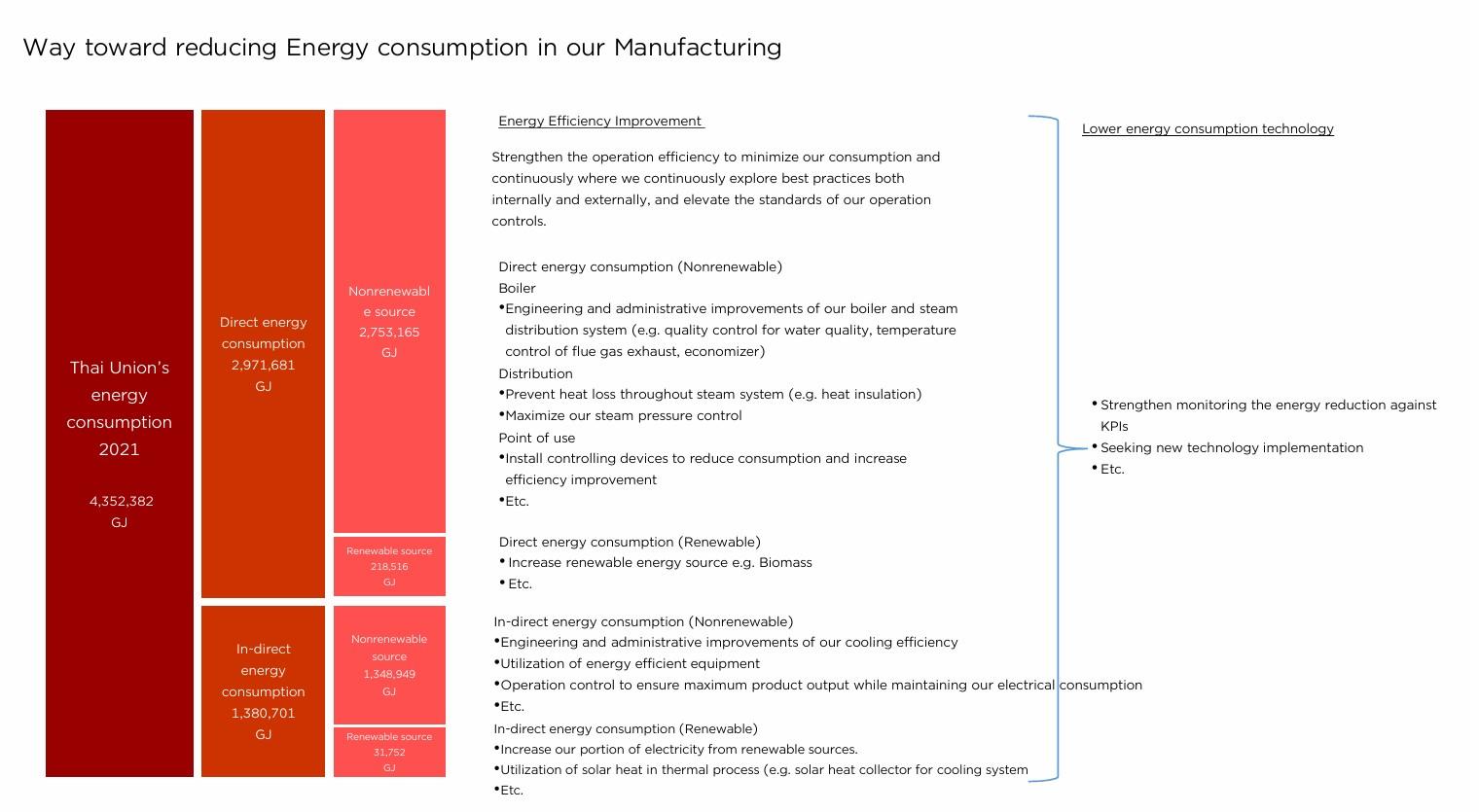
Despite a reduction in absolute energy consumption, we observed a slight increase in energy intensity per unit of finished goods. This was due to fixed energy consumption requirements, even with lower production volumes. As a food manufacturer, maintaining product quality requires consistent energy use, particularly for systems like our cooling operations.
Additionally, Thai Union is adopting low-carbon technologies such as solar energy, biomass, and greener energy solutions for mobile and stationary devices. These efforts have enabled Thai Union to reduce its greenhouse gas emissions and increase green energy consumption.
Plan Document Link
https://www.thaiunion.com/en/about/safety-health-and-environment
Energy — Electricity Consumption
Electricity Consumption
| Metric | Current Year | Previous Year | Two Years Ago |
|---|---|---|---|
| Total electricity consumption within the organization (Kilowatt-Hours) | 390,555,921.9 | 395,267,501.1 | 362,677,305.78 |
| Electricity purchased for consumption from non-renewable energy sources (Kilowatt-Hours) | |||
| Electricity purchased or generated for consumption from renewable energy sources (Kilowatt-Hours) |
Energy — Fuel Consumption
Fuel Consumption
| Metric | Current Year | Previous Year | Two Years Ago |
|---|---|---|---|
| Crude oil (Barrels) | |||
| Coal (Metric tonnes) | 21,070.15 | 34,108.53 | 53,701.56 |
| Jet fuel (Litres) | |||
| Diesel (Litres) | 3,420,134.69 | 4,387,881.5 | 4,893,965.47 |
| Gasoline (Litres) | 149,804.37 | 131,814.6 | 177,190.19 |
| Fuel oil (Litres) | 11,022,372.03 | 10,453,170.5 | 10,813,867.86 |
| Natural gas (Standard cubic feet) | 276,761,879.85 | 265,219,776.48 | 264,481,498.24 |
| LPG (Kilograms) | 5,397,031.23 | 5,534,956.24 | 4,600,730.11 |
| Steam (Metric tonnes) | 0 | 1,167.4 | 4,937.9 |
Energy — Targets
Has Set Targets
Yes
Targets
| Target | Base Year | Base Year Value | Target Year | Target Year Value | Target Change (%) | Unit | Unit — Please Specify | Per Unit (Intensity) | Per Unit — Please Specify |
|---|---|---|---|---|---|---|---|---|---|
| Reduction of electricity purchased and fuel consumption | 2,021 | 1,595.72 | 2,030 | 1,442.82 | 10 | Others | Gigajoules | Kilowatt-hour of product | Kilowatt-hour of product |
Energy — Performance & Outcomes
Has Performance Results
Yes
Performance Description
Thai Union has also launched the Shrimp Decarbonization initiative, developed in collaboration with The Nature Conservancy (TNC) and Ahold Delhaize USA, as part of efforts to improve the sustainability of aquaculture practices. Under the initiative, a pilot program targets producing 1,000 metric tons of processed shrimp that is both lower impact and meets the highest product quality standards. The shrimp, which will be fully traceable from hatchery to the final point of shipment, will be imported by Chicken of the Sea Frozen Foods.
We also announced a pioneering partnership with Chow Energy Public Company Limited, a solar energy leader, to significantly reduce our greenhouse gas emissions and promote the use of renewable energy across the Company’s supply chain. Under a Memorandum of Understanding, 30 megawatts of solar power projects will be installed for Thai Union's supply chain partners nationwide, equivalent to the annual electricity consumption around 17,500 homes. This initiative is part of Thai Union's commitment to sustainability, aiming to transform its supply chain into a low-carbon model.
Water — Plan & Guidelines
Has a Water Management Plan
Yes
Plan Description
Water availability is a critical factor for the resilience of our operations and supply chain. Using the WRI Aqueduct Water Risk Atlas 4.0, we assessed water-related risks across our manufacturing facilities and critical Tier 1 suppliers, including physical, regulatory, and reputational dimensions.
The assessment showed limited exposure to water stress, with 12 of the facilities located in stressed basins (extremely high > 80%). To further reduce potential impacts, we continue to improve water efficiency, increase reuse and recycling, and explore alternative water sources. In 2025, alternative water collection supplied 22% of the group’s total water consumption.
Plan Document Link
https://www.thaiunion.com/en/about/safety-health-and-environment
Water — Withdrawal, Discharge & Consumption
Water Withdrawal, Discharge & Consumption
| Metric | Current Year | Previous Year | Two Years Ago |
|---|---|---|---|
| Total water withdrawal (Cubic meters) | 9,198,738.09 | 9,233,691.83 | 9,311,308.22 |
| Total water withdrawal by third-party water (Cubic meters) | 4,986,775.21 | 5,180,418.1 | 5,136,441.89 |
| Total water withdrawal by surface water (Cubic meters) | 805,557.38 | 615,311.4 | 554,627.5 |
| Total water withdrawal by groundwater (Cubic meters) | 2,155,174.5 | 2,273,921.33 | 2,251,111.03 |
| Total water withdrawal by seawater (Cubic meters) | 1,251,231 | 1,164,041 | 1,369,127.8 |
| Total water withdrawal by produced water (Cubic meters) | 0 | 0 | 0 |
| Percentage of wastewater treated before discharge (%) | |||
| Total water discharge (Cubic meters) | 3,709,075.22 | 3,471,231.47 | 4,934,196.59 |
| Total water discharge to third-party water (Cubic meters) | 599,978.5 | 592,500.23 | 576,519 |
| Total water discharge to surface water (Cubic meters) | 2,680,507.22 | 2,297,250.52 | 3,689,733.27 |
| Total water discharge to groundwater (Cubic meters) | 0 | 0 | 0 |
| Total water discharge to seawater (Cubic meters) | 428,589.5 | 581,480.72 | 667,944.32 |
| Total water consumption (Cubic meters) | 5,489,662.87 | 5,762,460.36 | 4,377,111.63 |
| Recycled water (Cubic meters) |
Water — Targets
Has Set Targets
Yes
Targets
| Target | Base Year | Base Year Value | Target Year | Target Year Value | Target Change (%) | Unit | Per Unit (Intensity) | Per Unit — Please Specify |
|---|---|---|---|---|---|---|---|---|
| Reduction of water withdrawal | 2,021 | 6.31 | 2,030 | 5.66 | 10 | Cubic meters | Cubic meter of product | Cubic meter of product |
Water — Performance & Outcomes
Has Performance Results
Yes
Performance Description
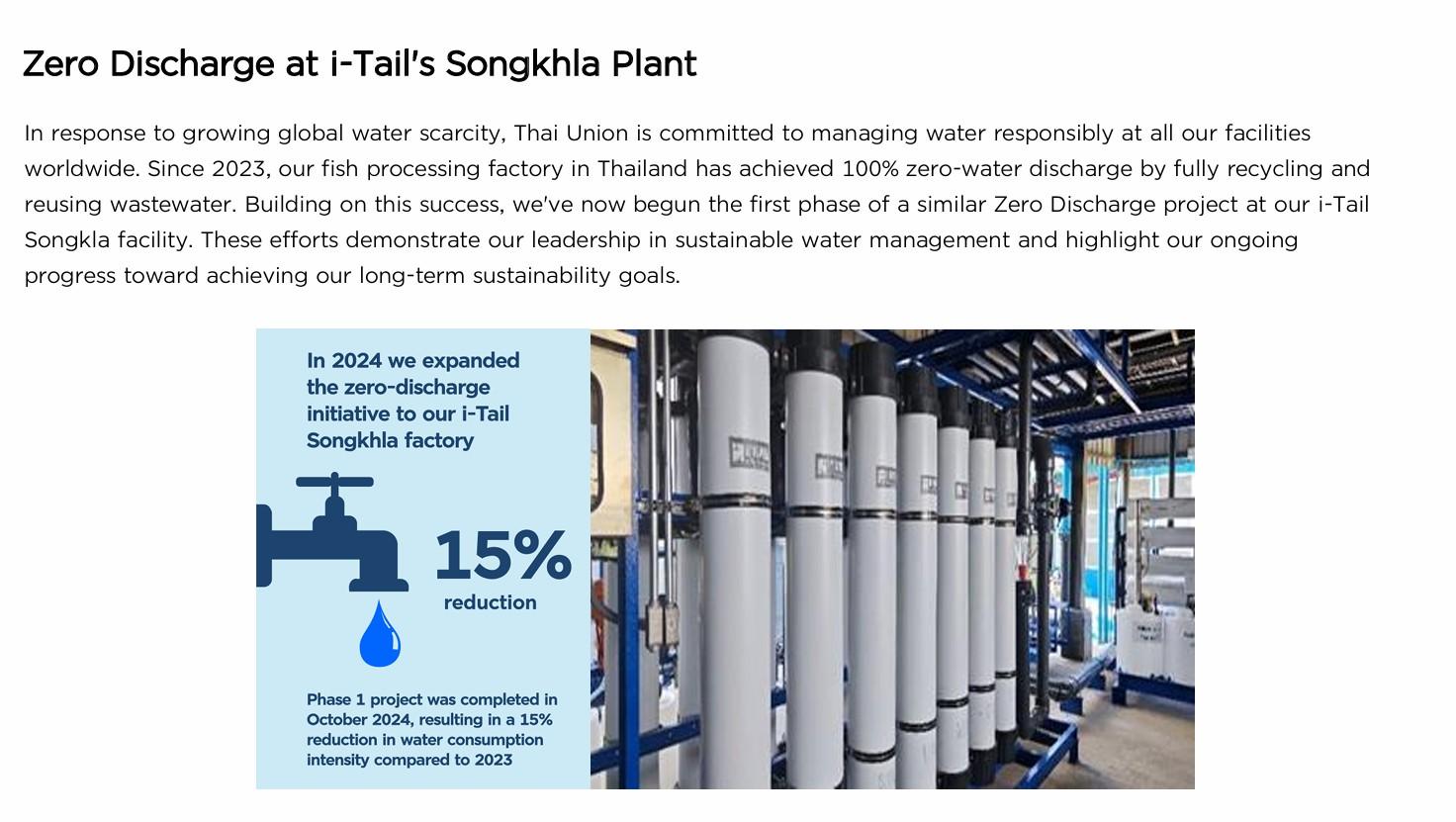
Thai Union set a new standard for seafood manufacturing with the completion of the Zero Wastewater Discharge Project at its fish plant in Thailand. This project, which is a pilot project for five of Thai Union’s factories, was developed in collaboration with the Program Management Unit for Competitiveness (PMUC) of Thailand’s Ministry of Higher Education, Science, Research, and Innovation (MHESI). It represents a significant milestone in achieving 100 percent wastewater treatment and supports our SeaChange 2030 strategy, which is committed to eliminating all water discharge, food waste, and waste to landfill by 2030.
The initiative began with an initial investment of THB 3.4 million from PMUC, complemented by Thai Union’s contribution of THB 8.4 million. The pilot project at the Samut Sakhon plant highlights Thai Union's dedication to environmental sustainability and marks a step forward in the Company's pursuit of best-in-class manufacturing standards. The plant, which covers an area of about 155,000 square meters, has successfully reduced its daily water consumption from 7 million liters to 4 million liters through innovative processes, including Ultrafiltration (UF) and Reverse Osmosis (RO). These technologies not only improve water quality but also facilitate the reuse, recycling, and recovery of water in industrial machinery systems. This reduction in water usage has led to significant cost savings, approximately THB 27.8 million annually.
The project's success is a result of Thai Union's strengthened focus on research and innovation to foster sustainable growth across the value chain. Over the years, the Company has worked closely with MHESI, PMUC, Mahidol University, and its dedicated team to implement the Zero Wastewater Discharge strategy. This approach is aligned with government principles of a circular economy, maximizing the use of natural resources to create added value.
The Zero Wastewater Discharge Project not only sets a new standard for sustainability within Thai Union's operations but also contributes to a global movement towards more responsible and environmentally conscious manufacturing practices. By achieving 100 percent wastewater treatment efficiency, Thai Union demonstrates that industrial growth and environmental stewardship can coexist, showcasing what can be accomplished when innovation, commitment, and collaboration converge for the betterment of our planet.
Waste — Plan & Guidelines
Has a Waste Management Plan
Yes
Plan Description
Our waste management approach is aligned with circular economy principles, prioritizing waste prevention and resource efficiency across our operations. Guided by the waste hierarchy such as prevention, reduction, reuse, recycling, and recovery, with landfill as a last resort. We aim to eliminate waste at its source and keep materials in use for as long as possible. This is achieved through systematic waste audits and performance reviews to identify high-impact waste streams, enabling targeted actions to reduce material losses and advance circular resource use.
Plan Document Link
https://www.thaiunion.com/files/download/sustainability/sd-report-2024-en.pdf
Waste — Generation, Disposal & Recycling
Waste Generation, Disposal & Recycling
| Metric | Current Year | Previous Year | Two Years Ago |
|---|---|---|---|
| Total waste generated (Kilograms) | 70,742,135.73 | 70,993,615.84 | 64,742,235.96 |
| Non-hazardous waste (Kilograms) | 69,840,060.51 | 69,789,489.23 | 63,873,580.93 |
| Non-hazardous waste - Landfilling (Kilograms) | |||
| Non-hazardous waste - Incineration (with energy recovery) (Kilograms) | |||
| Non-hazardous waste - Incineration (without energy recovery) (Kilograms) | |||
| Non-hazardous waste - Other disposal operations (Kilograms) | |||
| Hazardous waste (Kilograms) | 902,075.22 | 1,204,126.61 | 868,655.03 |
| Hazardous waste - Landfilling (Kilograms) | |||
| Hazardous waste - Incineration (with energy recovery) (Kilograms) | |||
| Hazardous waste - Incineration (without energy recovery) (Kilograms) | |||
| Hazardous waste - Other disposal operations (Kilograms) | |||
| Total reused/recycled waste (Kilograms) | 26,056,843.62 | 23,686,952.64 | 21,094,021.75 |
| Reused/Recycled non-hazardous waste (Kilograms) | 25,417,648.62 | 22,999,899.4 | 20,578,695.33 |
| Reused non-hazardous waste (Kilograms) | |||
| Recycled non-hazardous waste (Kilograms) | |||
| Reused/Recycled hazardous waste (Kilograms) | 639,195 | 687,053.24 | 515,326.42 |
| Reused hazardous waste (Kilograms) | |||
| Recycled hazardous waste (Kilograms) |
Waste — Targets
Has Set Targets
Yes
Targets
| Waste Type | Disposal Approach | Target | Base Year | Base Year Value | Target Year | Target Year Value | Target Change (%) | Unit | Per Unit (Intensity) | Per Unit — Please Specify |
|---|---|---|---|---|---|---|---|---|---|---|
| Non-hazardous waste | 2760 · Description: Landfilling | Reduce waste volume | 2,021 | 0.02 | 2,030 | 0.02 | 10 | Tonne | Metric ton of product | Metric ton of product |
Waste — Performance & Outcomes
Has Performance Results
Yes
Performance Description
Waste Mapping
Through waste mapping, we apply manufacturing techniques and technologies to improve equipment efficiency and prevent food loss and waste during processing, in line with our closed-loop processing approach. This maximizes the co-product utilization of tuna to keep materials in productive use.
In addition, we divert wastewater sludge from landfill by converting it into soil conditioners and fertilizers, repurpose boiler ash for use in concrete and bricks, and recover value through waste-to-energy solutions, alongside ongoing recycling initiatives. As a result, the intensity of waste sent to landfill decreased by 15% compared to 2025.
In 2025, 69% (20 out of 29) of manufacturing and distribution sites achieved zero waste to landfill status, exceeding our commitment to eliminate food waste and landfill disposal at five key global facilities.
GHG — Plan & Guidelines
Has a GHG Management Plan
Yes
Plan Description
Climate change is reshaping the global operating environment, intensifying extreme weather events and accelerating impacts on the world’s oceans. Rising temperatures, ocean warming, and acidification threaten marine biodiversity and aquaculture, while climate-related disasters such as floods and droughts increasingly disrupt production continuity, raw material availability, and workforce safety. In response to these risks, Thai Union has committed to Science-Based Targets aligned with the 1.5 Celsius pathway, aiming to reduce greenhouse gas emissions by 42% by 2030 and achieve net-zero emissions by 2050.
Plan Document Link
https://www.thaiunion.com/files/download/sustainability/sd-report-2024-en.pdf
GHG — Emissions
GHG Emissions
| Metric | Current Year | Previous Year | Two Years Ago |
|---|---|---|---|
| Total GHG emissions (Metric tonnes of carbon dioxide equivalent) | 2,747,018.5 | 2,517,297.59 | 434,360.95 |
| Total greenhouse gas emissions 1 (Metric tonnes of carbon dioxide equivalent) | 193,509.64 | 227,907.65 | 269,051.77 |
| Total greenhouse gas emissions 2 (Metric tonnes of carbon dioxide equivalent) | 171,390.86 | 177,961.94 | 165,309.18 |
| Total greenhouse gas emissions 3 (Metric tonnes of carbon dioxide equivalent) | 2,382,118 | 2,111,428 |
GHG — Emissions Verification
Emissions Verified by a Third Party
Yes
Verifying Body
2656
Verifying Body — Please Specify
LRQA (Thailand) Limited
GHG — Principles & Standards
Principles & Standards Applied
| Standard |
|---|
| 2671 |
| 2672 |
| 2675 |
| 2676 |
GHG — Targets
Has Set GHG Targets
Yes
GHG Targets — Net Zero
Net Zero Targets
| Emission Scope | SBTi Status | TGO Certification | Base Year | Base Year Emissions | Long-term Target Year | Long-term Target Change (%) | Unit |
|---|---|---|---|---|---|---|---|
| 2716 | Approve | Net zero | 2,021 | 4,599,711 | 2,050 | 95 | Metric tonnes of carbon dioxide equivalent |
GHG Targets — Other Targets
Other GHG Targets
| Emission Scope | Base Year | Base Year Emissions | Long-term Target Year | Long-term Target Change (%) | Unit |
|---|---|---|---|---|---|
| 2716 | 2,021 | 4,583,292 | 2,030 | 42 | Metric tonnes of carbon dioxide equivalent |
GHG — Performance & Outcomes
Has Performance Results
Yes
Performance Description
To deliver these commitments, we have implemented comprehensive decarbonization pathways focused on both operational excellence and technological transformation. These include energy optimization, strengthened engineering and administrative controls, and the deployment of low-carbon solutions such as high-efficiency machinery, expanded use of renewable energy, and adoption of advanced technologies. Compared with the 2021 baseline, Thai Union achieved a 29% reduction in greenhouse gas emissions in 2025, equivalent to approximately 147 million kilograms of CO2e.
In 2025, we invested approximately THB 216 million in low-carbon technologies, including biomass boilers, solar photovoltaic systems, and other energy-efficiency initiatives. These efforts were driven by a 67% decrease in coal-based energy consumption, a 297% increase in solar energy use, the expansion of the electric vehicle fleet, and the transition of freezing systems from carbon dioxide to nitrogen.
Environmental Legal Incidents
Legal Violation Incidents
| Metric | Current Year | Previous Year | Two Years Ago |
|---|---|---|---|
| Number of cases or incidents of legal violations or negative environmental impact (cases) | 0 | 0 | 0 |
Other Environmental Management
Plan Description
Responses to Climate-related Risks
Climate-related physical risks, including water-related impacts and other natural hazards, have been identified as material risks in line with IFRS S2: Climate-related Disclosures. This assessment demonstrates how climate considerations are embedded into our operational decision-making and long-term strategic planning. Adaptation measures addressing risks such as water scarcity from prolonged droughts, flooding, and other extreme weather events are monitored through the following indicators:
Impacts of actual natural hazard events on Thai Union facilities in the previous quarter, including earthquakes, tropical cyclones, floods, volcanic activity, and droughts
Medium- and long-term risk trend assessments for key hazards, including earthquakes, floods, tsunamis, tropical cyclones, and droughts
Key performance indicators (KPIs) to reduce water consumption
Plans to secure and diversify alternative water sources
Site-specific emergency response plans for natural disasters, including flood events
Employees — Plan & Guidelines
Has an Employee Management Plan
Yes
Plan Description
At Thai Union, we are committed to improving employees’ wellbeing, productivity, and capabilities. We have implemented initiatives to help our people balance their personal and professional responsibilities while prioritizing their emotional, mental, and physical wellbeing.
Additionally, we continue to focus on talent development and strengthening capabilities through the Thai Union Academy, offering upskilling and reskilling programs across high-demand curriculums. Our ongoing ambition is to increase employee engagement across all our businesses and employee demographics.
Thai Union conducts "TU Connect", a cornerstone of our global engagement strategy. This initiative provides sessions for two-way communication, enabling employees to directly connect with our CEO, executives, and management teams. Through multiple sessions conducted across regions, we encourage honest conversations, share company updates, and most importantly, listen to the voices of our people.
The feedback gathered during TU Connect is instrumental in shaping solutions that respond to real challenges, ideas, and opportunities raised by our employees. By creating an environment where every voice is heard and valued, we empower our teams to contribute to Thai Union’s growth journey, while fostering a culture of openness and engagement.
In 2025, the Company conducted an employee satisfaction survey with a strong emphasis on employee perspectives and feedback. Pulse Surveys were used to capture sentiment-based insights while reducing the burden of lengthy questionnaires amid rapid organizational changes. The survey results showed that the employee engagement level reached 84%, reflecting alignment in mindset, trust, and confidence in the organization’s various transformation processes. This indicates that employees have a clear understanding of, and are ready to support, the Company’s organizational transformation initiatives.
The voluntary turnover rate compared to total employees stood at 8.50%. To gain deeper insights, the Company conducted Exit Interviews to gather qualitative feedback from departing employees. The findings were used to enhance employee welfare and retention measures, as well as to analyze the root causes of turnover in order to strengthen the Company’s talent retention strategy. An annual Global Employee Engagement Survey is conducted to gain insights into the Company’s strengths and areas requiring improvement. In the latest survey, we received an impressive 93% response rate with an employee engagement level of 72%, exceeding the target of 70%. Additionally, the voluntary employees turnover ratio compared to the total employees in 2024 is at 9.76%. The findings revealed that employees value Thai Union’s collaborative environment, even with remote working arrangements. There was also a strong sense that supervisors are vested in colleague development. Based on this feedback, our regional teams have created dedicated employee engagement plans incorporating actions and initiatives derived directly from employee input.
Key Strategies for Engaging Our People
We understand the importance of our employees’ personal lives and well-being. We support them through flexible work arrangements, wellness programs, and other initiatives that promote physical and mental health. We provide a comprehensive benefits package that addresses the diverse needs of our workforce. We recognize that a one-size-fits-all approach is ineffective, and we strive to offer a range of options that empower employees to choose what best supports their well-being. In Thailand, our comprehensive benefits package includes pre-employment health screenings, basic healthcare provisions, health insurance, and annual health checks. We also provide benefits for vulnerable employees, such as pregnancy allowances and mothers’ breastfeeding rooms, and offer marriage allowance and leave to all legally married employees, regardless of gender identity or sexual orientation. We are committed to exploring ways to increase flexibility, such as offering optional benefits or a wellness spending account.
The employees turnover ratio compared to the total employees 18.90
Employee Engagement 84
Plan Document Link
https://www.thaiunion.com/files/sustainability/code-of-conduct/20160229-tu-code-of-conduct-en.pdf
Plan Areas
| Plan Area |
|---|
| Fair employee compensation |
| Employee training and development |
| Promoting employee relations and participation |
| Migrant/foreign labor |
| Child labor |
| Occupational health and safety in workplace |
Employees — Workforce
Employees with Disabilities — Introduction
Over the past year, the Company has implemented initiatives to support individuals with disabilities, employed a total of 403 persons with disabilities, fully meeting the number required by Thai law. Additionally, the Company has implemented a policy against all forms of harassment, discrimination and against any form of corruption or unethical practices.
Workforce Data
| Metric | Current Year | Previous Year | Two Years Ago |
|---|---|---|---|
| Total number of employees (Persons) | 12,529 | 13,483 | 13,030 |
| Number of male employees (Persons) | 5,473 | 5,799 | 5,639 |
| Number of female employees (Persons) | 7,056 | 7,684 | 7,391 |
| Total employment of disabled persons (people) | 401 | 391 | 367 |
| Total disabled employees (people) | 238 | 228 | 242 |
| Total male disabled employees (people) | |||
| Total female disabled employees (people) | |||
| Total disabled workers who are non-employee (people) | 163 | 163 | 125 |
| Contributions to the fund for promoting and improving the quality of life for disabled persons | 0 | 0 | 1 |
| Total number of male employees in operational level (Persons) | 4,850 | 5,132 | 4,940 |
| Total number of male employees in management level (Persons) | 584 | 620 | 648 |
| Total number of male employees in executive level (Persons) | 39 | 47 | 51 |
| Total number of female employees in operational level (Persons) | 6,404 | 7,061 | 6,741 |
| Total number of female employees in management level (Persons) | 647 | 621 | 647 |
| Total number of female employees in executive level (Persons) | 5 | 2 | 3 |
Employees — Remuneration & Provident Fund
Remuneration & Provident Fund
| Metric | Current Year | Previous Year | Two Years Ago | Remark |
|---|---|---|---|---|
| Total disabled employees (people) | 9,673,546,454.32 | 10,526,101,157.87 | 10,262,174,740.64 | |
| Total male employee remuneration (Baht) | 4,899,082,859.24 | 5,295,802,988.5 | 5,271,240,365.93 | |
| Total female employee remuneration (Baht) | 4,774,463,595.08 | 5,230,298,169.37 | 4,990,934,374.71 | |
| Number of employees eligible to participate in PVD (persons) | 11,254 | 12,193 | 11,681 | |
| Total number of employees joining employee provident fund (Persons) | 8,292 | 10,039 | 6,637 | The number of employees participating in the Provident Fund (PVD) in the Company and its subsidiaries located in Thailand 88.23% |
| Percentage of total number of employees joining employee provident fund to total number of employees (%) | 66.18 | 74.46 | 50.94 | |
| Number of PVD members / Total eligible employees (%) | 73.68 | 82.33 | 56.82 | |
| Total amount of provident fund contributed by the Company (Baht) | 187,439,884.36 | 342,777,495.22 | 197,571,599.41 | |
| Total amount of provident fund contributed by employee (baht) |
Employees — Training & Development
Training Data
| Metric | Current Year | Previous Year | Two Years Ago |
|---|---|---|---|
| Average employee training hours (Hours / Person / Year) | 3.17 | 3.76 | 6.19 |
| Employee development and training expenses (baht) | 20,380,029.99 | 41,720,311.05 | 28,581,625.68 |
Employees — Occupational Health & Safety
Occupational Health & Safety Data
| Metric | Current Year | Previous Year | Two Years Ago |
|---|---|---|---|
| Total number of lost time injury incidents by employees (Cases) | 181 | 168 | 137 |
Employees — Labour Relations
Labour Relations Data
| Metric | Current Year | Previous Year | Two Years Ago |
|---|---|---|---|
| Total voluntary resignations (Persons) | 1,065 | 1,316 | 1,287 |
| Male employees who voluntary resigned (Persons) | 434 | 504 | 549 |
| Female employees who voluntary resigned (Persons) | 631 | 812 | 738 |
| Percentage of employee turnover leaving the Company voluntarily (%) | 8.5 | 9.76 | 9.88 |
| Evaluation result of employee engagement | 1 | 1 |
Employees — Employee Representation
Employees Are Represented Collectively
Yes
Forms of Representation
| Form |
|---|
| Welfare committee |
Employees — Targets
Has Set Employee Targets
Yes
Targets
| Indicator | Target Areas | Base Year | Target Year | Target Year — Description |
|---|---|---|---|---|
| Global Employee Engagement Survey | 2985 · Description: Promoting employee relations and participation | 2,023 | 2,025 | Percentage 84 |
Employees — Performance & Outcomes
Has Performance Results
Yes
Performance Description
Throughout 2024-2025, Thai Union leveraged these commitments to drive industry-leading initiatives:
Strengthened ethical recruitment, grievance mechanism, and worker empowerment initiatives: Thai Union continued to implement the Employer Pays Principle and ethical recruitment policy, several worker voice and grievance mechanism programs, specifically expanded multilingual, confidential reporting systems, allowing employees and supply chain workers to share concerns, provide feedback, and participate in decisions that impact their workplace conditions, fostering accountability and trust.
Thai Union, in partnership with Mars Petcare, engaged in an assessment of three of our pet food facilities to understand what can be implemented on site and scaled across the group to continue efforts around ethical recruitment and employment. Results of the assessment (from December 2023 to July 2025) were positive and support future initiatives to further enhance worker safety and rights.
Fewer workers (<16%) reported that they had experienced or witnessed work-related incidents at the factories.
Workers reported paid recruitment fees dropped from 8.9% (hired prior Dec 2021) to 1.7% hired after Dec 2021.
Enhanced trust in the grievance mechanism increased from 26% to 82% - these are safe feedback and resolution systems or tools that allow employees to share concerns or complaints in a fair, safe, and timely way.
More workers (+8%) reported that they trust management.
More workers (+10%) reported being satisfied with Thai Union and would consider the company a good employer.
Independent Social Audits: The company collaborated with third-party organizations to conduct comprehensive social and human rights audits across high-risk supply chains, such as onboard distant water fishing vessels, leading to targeted remediation efforts where needed. The table below shows the percentage of the tuna volume we source from suppliers that are working to improve worker welfare and working conditions through Thai Union’s Vessel Improvement Program (VIP) in recent years:
Training and Awareness: Thai Union provided ongoing training for management, suppliers, and workers on human rights issues, fostering a deeper understanding of ethical practices and standards. Recent training conducted:
Migrant Health Volunteer Program: A pilot initiative in partnership with the Samut Sakhon Provincial Public Health Office, the Faculty of Tropical Medicine at Mahidol University, and the Proud Association to train health volunteers from within the migrant worker community. These health volunteers now help workers access healthcare services, raise awareness of non-communicable diseases, and promote preventive care, becoming a trusted bridge between migrant communities and healthcare providers. Since its launch in September 2024, 1,500 community members have benefited from the 109 volunteers that have been trained, of which 23 serve as translators in local hospitals. This helps address one of Thailand’s most pressing health challenges, with noncommunicable diseases accounting for 74% of all deaths in the country.
First Aid/CPR and health and safety trainings: The collaboration with the Seafood Taskforce continued to roll out occupational health and safety trainings for workers in aquaculture farms and those working on fishing vessels. For aquaculture training, it included the periodic checking of safety equipment and how to appropriately use fire extinguishers. For fishing vessel training, the focus is for all crew to know how to use CPR and first aid skills while out at sea.
Thai Union strengthened partnerships with stakeholders, including human rights organizations and industry peers, to address systemic issues such as forced labor in global seafood supply chains. The company’s involvement in the Seafood Task Force and similar collaborative platforms underscores its leadership in advocating ethical labor practices industrywide.
As Thai Union reflects on its human rights performance in 2024-2025, the company recommits to upholding the fundamental human rights of all workers and maintaining an equitable, safe, and inclusive workplace. Moving forward, the focus will be on strengthening human rights due diligence, deepening engagement with supply chain partners, advancing data-driven systems for monitoring remediation, and fostering a culture of transparency and accountability for respecting human rights. Thai Union's dedication to human rights is a cornerstone of its mission to lead the global seafood industry toward a sustainable and responsible future.
Employee Engagement
Thai Union continues to strengthen its commitment to building an engaged, empowered, and future-ready workforce by investing in human capital development, continuous learning, and a supportive work environment. In 2025, the company advanced its focus on employee engagement through enhanced performance management systems, expanded development programs, and initiatives that promote well-being, inclusion, and global alignment.
A core element of engagement is Thai Union’s Performance Management which ensures employees are aligned with Enterprise Objectives and functional expectations through structured goal setting and performance reviews. Currently, the process includes twice-yearly goal-setting and mid-year reviews, using the SMART framework to integrate both business and personal development goals. This approach ensures fair, transparent, and adaptive performance discussions.
Starting in 2026, Thai Union will strengthen this framework with the “ONE Thai Union” Performance Management, defining key priorities, and introducing a one on one performance dialogues to foster deeper alignment and personalized development. These enhancements aim to create stronger connections between employees and line managers, ensuring clarity on expectations and growth opportunities.
Complementing this, Thai Union applies a multidimensional appraisal approach, including team feedback for senior leaders, which promotes self-awareness, teamwork, and alignment with the Thai Union People Leadership Standard, while ongoing agile conversations encourage open dialogue, real-time feedback, and continuous improvement.
Thai Union’s long-term incentive plan reinforces engagement and retention by rewarding sustained performance and aligning leadership with shareholder value. The plan plays a strategic role in attracting external talent while strengthening loyalty among key leaders.
Learning, development, and career growth remained central to employee engagement in 2025. Thai Union expanded self-paced learning through global platforms and continued to promote internal job rotations, enabling employees to explore new roles and gain cross-regional experience.
Thai Union also continued to foster a culture of inclusion and shared values through its Culture Development and DEI/JEDI programs. Through structured onboarding, e-learning, workshops, and internal campaigns, employees are supported to embody the company’s 6 Values and deepen their understanding of equity, belonging, and inclusive behaviors. Platforms such as Viva Engage strengthened cross-functional collaboration and global knowledge sharing, reinforcing a sense of community across regions.
Employee well-being remained a priority, with holistic, life-stage programs such as Mother’s Class and Happy Retirement supporting both personal and professional transitions. Cultural and community activities, including Pride Month, Songkran celebrations, and year-end gatherings, further enhanced team cohesion and a joyful, inclusive workplace.
To support global alignment, Thai Union introduced the SeaChange 2030 e-Learning module and the Strategy 2030 Learning File, ensuring all employees understand the company’s sustainability roadmap and their role in driving long-term success.
Through these integrated efforts, Thai Union continues to build an engaged workforce equipped to contribute to the company’s strategic ambitions and sustainability leadership.
Customers — Plan & Guidelines
Has a Customer Management Plan
Yes
Plan Description
Annual Targets and Performance for 2025
The Company conducted an online customer satisfaction survey for customers who purchased products through digital channels, providing opportunities for customers to share feedback and rate their actual user experience in order to reflect consumer perspectives and expectations. In 2025, the Company achieved an overall satisfaction score of 98%, exceeding the target of 96%. The Company systematically analyzed insights derived from customer comments and suggestions and used them to continuously improve product quality, packaging, and services in 2026. This also includes enhancing the digital customer experience to ensure greater convenience, speed, and security, in compliance with personal data protection measures and applicable laws. In addition, the Company remains committed to designing and developing products that align with the behaviors and needs of consumers in the digital era in a sustainable manner, with the objective of enhancing customer satisfaction and creating long-term value for customers.
*Customers who purchase Sealect products.
Plan Areas
| Plan Area |
|---|
| Responsible production and services for customers |
| Communication of product and service impacts to customers/consumers |
| Development of customer satisfaction and customer relationship |
| Protection of customer personal information |
Customers — Satisfaction Results
Customer Satisfaction Results
| Metric | Current Year | Previous Year |
|---|---|---|
| Evaluation results of customer satisfaction | 1 | 1 |
Customers — Targets
Has Set Customer Targets
Yes
Targets
| Indicator | Target Areas | Base Year | Base Year — Description | Target Year | Target Year — Description |
|---|---|---|---|---|---|
| Customer satisfaction survey | 3009 · Description: Development of customer satisfaction and customer relationship | 2,025 | Percent 98 | 2,025 | Percent 96 |
Customers — Performance & Outcomes
Has Performance Results
Yes
Performance Description
The Company’s policy is to treat customers with the following responsibilities:
The Company has produced quality food under Food Safety and hygienic and traceability under standardized manufacturing process technology and appropriate technology, including the development of new products and processes high quality, as well as surveying customer satisfaction to ensure customer benefit and satisfaction.
The Company determines the price of goods and services at an appropriate level of detail and quality of products and services as customers demand.
The Company ensures its costs are as reasonable as possible while maintaining quality of service standards, according to the Company’s customer requirements.
The Company delivers high quality products and services to meet or exceed customer expectations and on-time delivery adhering to commitments given to customers includes providing service warranties under appropriate terms and conditions.
The Company treats customers politely, hospitably and with honesty, pays attention to every customer with fairness equality without bias.
The Company complies with the contract terms or conditions, and if not viable, will inform customers in advance and find a solution to prevent irreversible damage to stakeholders and does not impose unfair trade terms on customers.
The Company provides information regarding the instructions on the product features and specifications of goods and services, as well as how to use. The Company also keeps customers informed about the products and other services in a timely manner for customers to have adequate information, with no overstating, so there is no misunderstanding about the quality or condition of any products or services, to maintain good relations with customers.
The Company focuses on maintaining the confidentiality of customer information, not disclose customer’s information for their own or related parties’ benefit for whatever reason. The Company has implemented guidelines for protecting customer privacy in accordance with the Personal Data Protection Act, including cybersecurity measures.
The Company implemented channels, procedures and dedicated personnel to handle customer complaints regarding products and services, while also maintaining a commitment to promptly respond and resolve such concerns. Customers can file complaints by providing complaint information, along with their names, addresses, and contact numbers. All information will be treated as confidential, ensuring no returning adverse effects and with robust measures to protect the complainants. Complaints can be submitted via the designated channel: https://investor-th.thaiunion.com/complaints_handling.html
The Company will not receive bribes from customers.
Community & Social — Plan & Guidelines
Has a Community & Social Plan
Yes
Plan Description
Thai Union remains deeply committed to supporting communities, promoting health and well-being, and providing assistance in times of crisis. In 2025, the Company strengthened its Corporate Social Responsibility (CSR) impact through targeted initiatives focused on disaster relief, inclusive healthcare, and support for vulnerable populations across Thailand and the region. These efforts are guided by Thai Union’s long-term CSR strategy under SeaChange 2030, which emphasizes building resilient communities and sustainable value chains across our five core business segments, Ambient, Frozen, Pet, Ingredient and Feed and focusing on health & wellbeing, livelihood and skill development program including disaster relief.
Plan Areas
| Plan Area |
|---|
| Education |
| Forests and natural resources |
| Occupational health, safety, health, and quality of life |
Community & Social — Targets
Has Set Community & Social Targets
No
Community & Social — Performance & Outcomes
Has Performance Results
Yes
Performance Description
A key priority this year was rapid humanitarian response following natural disasters. Immediately after the Bangkok earthquake, Thai Union provided essential relief supplies to affected residents and rescue teams working on the front lines. The support included food, beverages, and daily necessities to help meet urgent needs during the early stages of the crisis. Thai Union also extended its support beyond Thailand’s borders by donating THB 1 million to the International Organization for Migration (IOM) to aid earthquake-affected communities in Myanmar. This contribution helped IOM deliver emergency shelter, medical care, and essential supplies to displaced and vulnerable individuals, reflecting Thai Union’s commitment to acting swiftly and responsibly in regional emergencies.
Building on this commitment to timely disaster relief, Thai Union also responded to severe flooding in Southern Thailand in December 2025. The Company and its subsidiaries delivered essential food products and daily necessities worth THB 6 million to support affected communities and employees. Nearly 5,200 relief bags were distributed two rounds to support our employees affected by the flooding, and additional assistance was provided to help ease the financial burden of home repairs and recovery—underscoring Thai Union’s focus on both community resilience and employee well-being during times of crisis.
Health and well-being continued to be a major focus of CSR activity in 2025. In Samut Sakhon, Thai Union advanced its Migrant Health Volunteers Program, an initiative designed to strengthen inclusive healthcare for migrant workers. Through structured training in non-communicable disease prevention, health literacy, and medical rights, the program empowers migrant volunteers to act as trusted health ambassadors within their communities. Implemented in collaboration with public health authorities and local partners, the initiative enhances access to reliable health information, builds stronger community networks, and contributes to safer, healthier working and living environments.
The program has trained 109 migrant workers through a combination of online and on-site sessions. After completing their training, the volunteers have been assisting in the Subdistrict Health Promoting Hospital and community health activities, with 23 serving as interpreters, working alongside Thai health officials and Village Health Volunteer (VHV) to facilitate communication with migrant patients. Their outreach has supported vaccination drives, connected workers to health insurance, and shared knowledge across workplaces and communities, benefiting over 1,500 community members.
Building on this success, the Samut Sakhon Provincial Public Health Office will integrate the initiative into its ongoing work, including additional training to update knowledge and skills aligned with the Department of Health Service Support standards, Once completed, volunteers will be officially registered with the Department of Health Service Support, enabling them to continue advancing equitable healthcare across the province.
As part of its commitment to building resilient, inclusive coastal communities and safeguarding sustainable seafood value chains, Thai Union partnered with the Thai Sea Watch Association to launch an 18-months project, the Waste Management for Coastal Fishing Communities program in Songkhla and Phatthalung provinces. The program empowers local communities to manage waste responsibly from source to destination, reduce the risk of microplastic in seafood and establish a self-sustaining community waste management fund that can support future activities. So far, 83 model households from the two provinces have joined the program, learning how to recycle and dispose of waste responsibly, and inspiring others to follow. Waste banks are being set up in each location, managed by committees that include model households, community members and local government representatives. By the end of the program in April 2026, the initiative aims to achieve a 50% reduction in community waste, create waste banks that generate economic benefits and build a sustainable fund to keep environmental protection activities going, delivering long-term benefits for community livelihood.
These efforts underline Thai Union’s belief that strong, inclusive communities are essential to long-term business resilience and sustainable development. Whether through emergency relief, cross-sector partnerships, or programs that promote equitable access to healthcare, Thai Union continues to act with responsibility and compassion, supporting the people and communities who form the backbone of the seafood industry.
Law Violation Incidents
Law Violation Incidents
| Metric | Current Year | Previous Year | Two Years Ago |
|---|---|---|---|
| The total number of cases or incidents of significant violations of laws or regulations regarding social and human rights (Cases) | 0 | 0 | 0 |
| The total number of cases or incidents that cause significant labor disputes (Cases) | 0 | 0 | 0 |
| The total number of cases or complaints related to consumer rights violations (Cases) | |||
| The total number of cases or complaints related to partner rights violations (Cases) | |||
| The total number of cases or incidents that cause disputes with the community/society (Cases) | |||
| The total number of cases or incidents related to cyber security or customer data breaches (Cases) | |||
| The total number of cases or incidents related to safety and occupational health at work (Cases) |