

Risk Management · 2025
In this section3 topics
Risk Management Policy & Plan
Policy & Plan Description
Thai Union Group has been listed on the Dow Jones Sustainability Indices (DJSI) for eleven consecutive years and, in 2025, achieved a 100th percentile score for risk and crisis management. This performance reflects the company’s longstanding commitment to robust, systematic risk management across the group and its subsidiaries.
Thai Union recognizes that effective risk management is fundamental to good corporate governance, investor confidence, and the achievement of its purpose, Healthy Living, Healthy Oceans. Despite ongoing global challenges, the company continues to embed a strong risk culture at all levels of the organization.
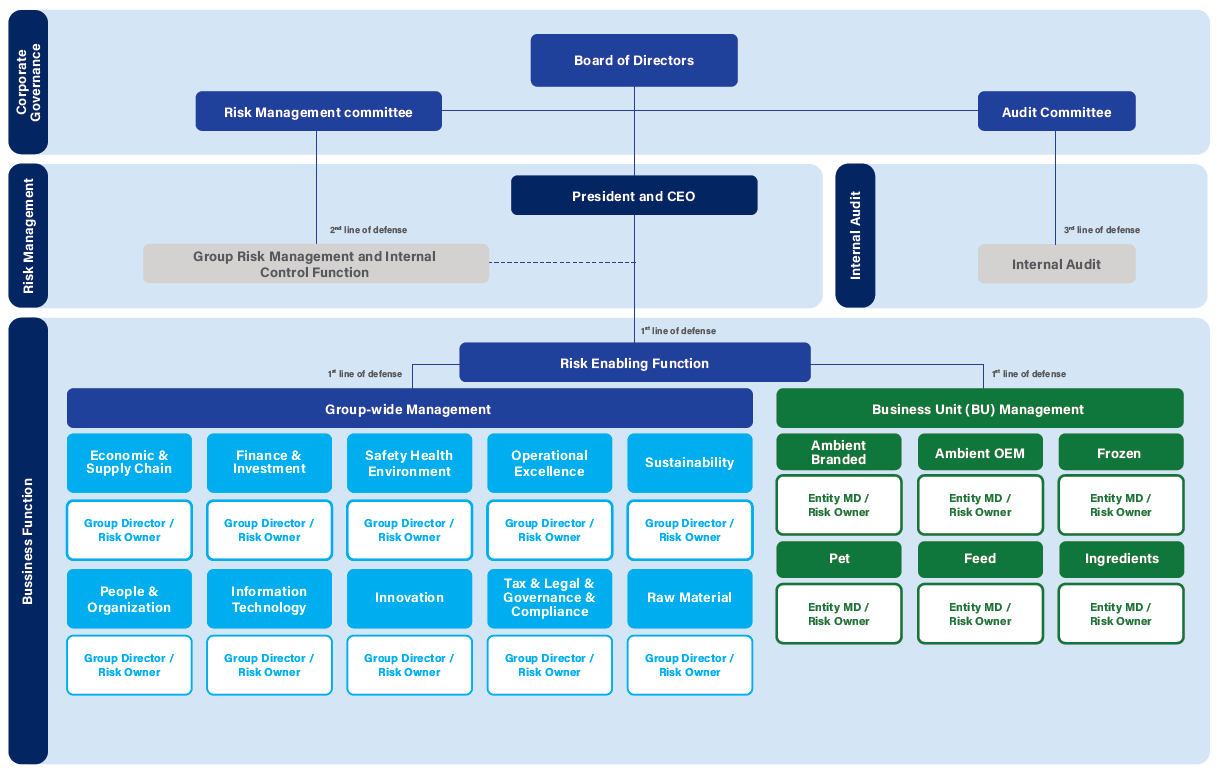
The company has established a clear risk management structure with well-defined roles and responsibilities. The Board of Directors (BoD) provides oversight of enterprise risk management and approves the company’s risk appetite. To support this oversight, the BoD has appointed a Risk Management Committee (RMC) to oversee the implementation of risk management, monitor key risks, and review mitigation measures on a regular basis.
The RMC comprises independent directors and senior executives with relevant business and risk management expertise, and is chaired by an independent director, ensuring objective and effective governance. The President and CEO are responsible for ensuring that risk management is implemented appropriately and effectively throughout the organization.
At the operational level, risk management activities are overseen by Ms. Umaporn Kittipoomwong, Director of Risk Management and Internal Control, who reports directly to the RMC and has a dotted line reporting relationship to the President and CEO. She plays a key role in implementing the Groupwide risk management program and in providing guidance on the risk management framework and processes to risk enabling functions.
Risk owners are responsible for identifying, assessing, and managing risks in line with Thai Union’s risk management guidelines, while management and employees are accountable for managing risks within their respective areas of responsibility.
Risks to the Company's Business Operations
Risk Register
| Risk Name | Risk Characteristics | Consequences | Management Measures | Related Risk Factors |
|---|---|---|---|---|
| Global Economic, Damand and Supply Chain Challenges | In 2025, Thai Union continues to face significant challenges driven by global economic uncertainty and ongoing supply chain disruptions. Persistent geopolitical tensions among major economies—including the United States, the European Union, and China—have intensified trade conflicts and tariff risks, creating a highly volatile environment for international seafood trade. Inflationary pressures remain elevated, while financial markets have been highly unstable, with pronounced currency fluctuations adding further complexity. At the same time, geopolitical disruptions—such as the Red Sea crisis, which forced vessels to reroute, increasing transit times—combined with tariff uncertainty have further strained supply chain efficiency. | These global dynamics have had both direct and indirect impacts on Thai Union’s operations.
| To address the combined challenges of global economic uncertainty, supply chain disruptions, and tariff risks, Thai Union implemented a multi-pronged strategy focused on operational resilience, cost control, and long-term transformation:
| 733 · Description: Business operations of partners in the supply chain · Info category: STRATEGIC_RISK · 1715 · Description: Economic risk · Info category: STRATEGIC_RISK |
| Investment Risk | To become the world’s leading marine health & nutrition company, our Strategy 2030 is built on three growth pillars – (1) Defend the core, (2) Next wave of growth, and (3) Group-level growth drivers, all underpinned by a foundation of strategic enablers. Therefore, strategic investment is playing an important role to support how-to-win these strategies. Doing so not only brings us numerous opportunities but also reduces risks of lower-than-targeted returns on investment from economic or competition, laws and regulations, technology selection, resource management, and other sustainability related issues. | In 2025, Thai Union Group did not engage in any major mergers, acquisitions, joint ventures, or significant investments in new business categories. The impact of investment-related risks remains limited, primarily associated with the financial perspective and arising from a small number of existing loss-making businesses. Looking ahead to future investments under Strategy 2030, the company acknowledges potential impacts from investment-related risks. These include the possibility of returns falling short of targets due to factors such as economic conditions, competitive dynamics, regulatory changes, inappropriate technology adoption, inefficient resource management, and sustainability considerations. Consequently, the company places strong emphasis on rigorous risk assessment and proactive management to safeguard stability and ensure sustainable long-term growth. | We have enhanced the investment process to minimize risks as well as provide a balance with business opportunities:
Once the investments have been approved by GLT or the BoD, investment performance and risk monitoring takes place by management and the Group Risk Management department. Key investments will be reported to the RMC once they foresee a deviation or risk with a mitigation plan to ensure minimum impact on project objectives and corporate strategies. For loss-making businesses, the company continues to monitor performance very closely and implement turnaround strategies or pursue divestment, depending on which approach is most advantageous to the company’s strategic objectives. | 765 · Description: Fluctuation in return on assets or investment · Info category: FINANCIAL_RISK · 746 · Description: Delays in the development of future projects · Info category: OPERATIONAL_RISK · 1715 · Description: Economic risk · Info category: STRATEGIC_RISK · 1716 · Description: New business risk · Info category: STRATEGIC_RISK |
| Trade Tariff | In a global climate of escalating trade tensions, tariffs on seafood and pet food imports present a significant risk to Thai Union Group. In April 2025, the Trump administration announced it would increase Thailand’s tariff rate to 36%. After negotiations, on August 1, 2025, the U.S. announced a revised tariff rate of 19%, in line with other major seafood exporting nations globally. Under the new regime, Thailand faces a combined tariff burden of approximately 31.5% on ambient canned tuna in water and 19% on frozen and pet care products. Given that the U.S. market accounts for 38% of Thai Union Group’s total sales, the tariffs pose a significant risk to profitability, market competitiveness, and supply chain stability. Furthermore, amid ongoing global trade tensions and geopolitical pressures, Thai Union Group anticipates that uncertainty will persist into 2026, remaining a key risk driver for the company. | The tariff increases are expected to elevate landed costs for U.S.-bound products, compressing margins and reducing price competitiveness. Customer responses include delayed orders, requests for rebates, and exploration of alternative sources from lower-tariff jurisdictions.
| Thai Union has implemented a comprehensive mitigation strategy to address the tariff risk: Short-Term Strategies
Medium- to Long-Term Strategies Following the August 1, 2025, announcement of the final U.S. tariff rate (19%), Thai Union remains competitive compared to peers:
To strengthen our competitiveness, additional measures were implemented included:
These actions aim to safeguard profitability, ensure supply continuity, and leverage Thai Union’s global footprint to maintain competitiveness in the U.S. market. | 756 · Description: Change in laws and regulations · Info category: COMPLIANCE_RISK · 757 · Description: Laws and regulations is not favorable for doing business · Info category: COMPLIANCE_RISK · 762 · Description: Change in financial and investment policies of financial institutions that affect business operations · Info category: FINANCIAL_RISK · 730 · Description: Government policy · Info category: STRATEGIC_RISK · 731 · Description: Policies or international agreements related to business operations · Info category: STRATEGIC_RISK |
| Uncertainties in Financial Markets, Currency, and Interest Rates | With a presence in many countries, the company is exposed to a variety of financial risks coming from foreign exchange, interest rates, liquidity, trade receivables, counterparty risk, theft and fraud risk, geopolitical risk, investment and borrowing activities, etc. The risks are primary:
| In 2025, several key financial risks continue to evolve amid a shifting global economic environment. Inflationary pressures have moderated, particularly in regions where central banks begin gradual rate cuts, which could lead to uncertainty economic growth and uneven liquidity. Geopolitical uncertainties, such as the ongoing impacts of conflicts like the war in Ukraine and new regional tensions, may continue to disrupt global trade and supply chains, increasing costs and affecting business operations. Additionally, volatility arising from U.S. reciprocal tariffs and retaliatory trade actions is expected to increase market uncertainty. Financial markets remain exposed to volatility, driven by shifting risk sentiment, interest rate adjustments, and slowdowns in major economies. Moreover, foreign exchange risk is expected to intensify, with fluctuations in currency markets influenced by divergent central bank policies, economic instability, and geopolitical events. Companies with international exposure may face losses from unfavorable currency movements, particularly in emerging markets where volatility may increase as investors react to changing yield differentials or commodity prices. In addition, the growing focus on sustainable finance and regulatory compliance introduces new considerations for companies accessing capital market, while cybersecurity threats and rapid digital transformation continue to pose operational vulnerabilities. Collectively, these factors will challenge financial risk environment and could impact corporate earnings, investment strategies, and global economic recovery efforts. | The Company’s overall risk management program focuses on the unpredictability of financial markets and seeks to minimize potential adverse effects on the Group’s financial performance. The Company uses derivative financial instruments to hedge certain exposures to stabilize future earnings. The Financial Risk Management Policy is carried out by the Executive Group Committee. The Company’s policy includes areas such as foreign exchange risk, interest rate risk, liquidity risk, counterparty credit risk, raw material risk and operational risk. The framework parameters are approved as shown below:
Financial risk management and hedging strategies have become a critical role for business to mitigate these potential impacts in FY2025. | 730 · Description: Government policy · Info category: STRATEGIC_RISK · 764 · Description: Fluctuation in exchange rates, interest rates, or the inflation rate · Info category: FINANCIAL_RISK · 765 · Description: Fluctuation in return on assets or investment · Info category: FINANCIAL_RISK · 1715 · Description: Economic risk · Info category: STRATEGIC_RISK |
| Taxation: Pillar Two | Base Erosion and Profit Shifting (BEPS) Pillar Two is one of the global initiatives led by the Organization for Economic Cooperation and Development (OECD), aimed to establish a global minimum tax rate at 15 percent to ensure that Multinational Enterprises (MNEs) pay a fair share of taxes in all jurisdictions they operate in. | This initiative would impact Thai Union Group on the following aspects:
| The company has assessed the impact of Pillar Two, identified jurisdictions qualifying for the Transitional Country-by-Country Reporting Safe Harbor, prepared financial data for Pillar Two compliance calculations, and developed an implementation plan to comply with relevant laws and regulations. Additionally, the company is developing a response plan focused on mitigating risks under Pillar Two, ensuring alignment with corporate strategy. | 756 · Description: Change in laws and regulations · Info category: COMPLIANCE_RISK · 757 · Description: Laws and regulations is not favorable for doing business · Info category: COMPLIANCE_RISK · 762 · Description: Change in financial and investment policies of financial institutions that affect business operations · Info category: FINANCIAL_RISK · 730 · Description: Government policy · Info category: STRATEGIC_RISK · 731 · Description: Policies or international agreements related to business operations · Info category: STRATEGIC_RISK |
| Raw Material - Tuna | In 2025, the price of skipjack tuna in Bangkok, landed from the Western Pacific Ocean and mainly used for our tuna ambient OEM and U.S. business, remained stable and aligned with budget expectations. This stability was largely due to average-to-low catches and reduced demand in the region. Our purchases decreased by 25% compared to the previous year because of very low demand. Nonetheless, we will end the year with a high inventory of tuna.
In 2025, total skipjack catches in the Indian Ocean were 2% lower than the previous year. After meeting local facility needs in Seychelles, Mauritius, and Madagascar, significant volumes were exported to Turkiye, Bangkok, Vietnam, the Philippines, and even Ecuador, where fleets achieved higher sale prices. Although prices started out higher, they fell sharply in the second half due to robust catches and better-sized fish. The price of Indian Ocean skipjack ended up 2% below budget. Skipjack catches in the Atlantic were strong, particularly from June onward, which allowed supply to come mostly from local fleets and reduced dependence on imports from Abidjan, Dakar, or the Indian Ocean. The price of Atlantic skipjack was also 2% below budget. The yellowfin (YF) tuna price in the Western Pacific fell 4% below budget, primarily due to weaker demand after the U.S. tariffs hike significantly lowered consumption. In the Indian Ocean, YF+10 (yellowfin over 10kg) catches were generally weak throughout the year, but prices still dropped significantly—ending 7% below budget—mainly because of abundant supply redirected from the Eastern Pacific into European markets. Atlantic Ocean YF+10 catches also disappointed, yet prices benefited from surplus stocks in Europe and finished the year 12% under budget. | In 2025, lower-than-expected prices, especially for yellowfin, made it difficult to raise tuna prices. Results varied by region and brand. Shelf price gaps between branded and private label products stayed large, with retailers increasing private label prices less than those of major brands. | The company has a global fish procurement team with extensive experience to strengthen our strategic sourcing and supply chain management. Through centralized sourcing, we capitalize on our global reach and have developed top-tier capabilities, sharing daily updates on significant tuna movements worldwide as well as the activities of fishing vessels. Operationally, the team closely tracks prices and supply challenges, taking action to address these issues as they arise. The Fish Procurement Team maintains constant communication across all Thai Union factories and with our Commercial Teams, ensuring that all internal stakeholders receive up-to-date information on current prices and forecasts for the next 6 to 12 months. The company diversified its supply sources by procuring raw materials from different oceans, which helped offset supply challenges—especially considering the price variations mentioned earlier. When certain regions experienced low catches and high prices, we managed risk by expanding sourcing from other oceans. For instance, substantial quantities of tuna were shipped from the Indian Ocean to both Thailand and Vietnam. The new cold storage facility in Ghana enabled us to maximize purchases from the local fleet during peak catch season starting in June, reducing costs compared to using third-party cold stores and lowering imports, which incur additional freight costs. Meeting plant demand remains a top priority to ensure stable production and operations. To achieve this, we further expanded our annual contracts in the Western Pacific, Indian, and Atlantic Oceans, guaranteeing a minimum supply even during periods of low catch. We project skipjack tuna prices across all oceans to range from USD 1,550 to 1,750 per metric ton in 2026. Overall, 2025 was a satisfactory year for supply: there were no major shortages at our plants, and we achieved lower-than-budgeted tuna prices. | 729 · Description: Behavior or needs of customers / consumers · Info category: STRATEGIC_RISK · 740 · Description: Shortage or fluctuation in pricing of raw materials or productive resources · Info category: OPERATIONAL_RISK |
| Raw Material – Shrimp | In 2025, global shrimp production remained broadly in line with 2024 levels, increasing slightly by approximately 2%. This growth is primarily supported by the expansion of black tiger shrimp (Penaeus monodon) farming in India and Vietnam, resulting in an overall increase of around 2% in shrimp production across Asia, covering all species. At the same time, Ecuador—the world’s largest producer of whiteleg shrimp (Litopenaeus vannamei)—is expected to continue expanding production at a rate of approximately 3–4%, supported by farming efficiencies and a sustained cost advantage. However, several major producing countries continue to face challenges from environmental factors, elevated production costs, and shrimp disease, which continue to affect survival rates and overall production stability. In Thailand, shrimp prices in 2025 are expected to remain volatile, influenced by seasonal factors, export demand, and trade policy uncertainty, particularly following the announcement of U.S. import tariffs earlier in the year, which affected short-term market sentiment. Thai shrimp prices typically peak during the first and fourth quarters and remain higher than those of other major producing countries such as Indonesia, India, and Ecuador, due to limited growth in domestic production combined with persistently high feed and energy costs. In response to these challenges, some Thai shrimp farmers have adjusted their strategies by placing greater emphasis on black tiger shrimp farming to target premium market segments that prioritize superior texture, firmness, and coloration compared to white leg shrimp. Key Factors Impacting Shrimp Production
| In 2025, the Thai shrimp industry continues to face challenges from shrimp disease outbreaks and climate variability, which result in inconsistent production volumes and survival rates, increasing uncertainty in income and cash flows for operators. In addition, elevated production costs—including feed, energy, and labor—have driven higher unit costs and margin pressure, particularly for small-scale farmers with limited access to capital and technology. From a market perspective, Thai shrimp prices remain higher than those of other major producing countries, reducing price competitiveness in mass-market segments. At the same time, uncertainty surrounding international trade policies—particularly U.S. import tariff measures—has weighed on market sentiment and short-term investment decisions. Despite these constraints, clear investment opportunities remain for operators that can shift from price-based competition toward quality-driven differentiation. This is particularly evident in the development of black tiger shrimp (Penaeus monodon) and premium shrimp products that emphasize superior texture, quality, and brand positioning, which help enhance value and reduce exposure to price competition. Furthermore, disease and production risks have created opportunities for investment in farms with strong biosecurity systems, advanced farming technologies, and production standards aligned with global market requirements. Seasonal price strength in certain periods also provides opportunities for well-managed operators to generate more stable returns over the medium to long term, by effectively managing both risks and opportunities associated with the industry. | Marketing: The company will focus on market diversification and the development of value-added product segments, particularly premium shrimp products, to reduce exposure to commodity market volatility and enhance its ability to sustain pricing over the long term. Procurement and Supply Chain: The company will continue to prioritize efficient raw material management through systematic production planning and cost analysis, alongside the management of raw material imports to enhance operational flexibility. At the same time, emphasis is placed on responding to local market requirements to mitigate supply risks. In addition, the Company will strengthen communication and collaboration with stakeholders across the supply chain to build confidence in shrimp supply in terms of volume, quality, and pricing. These efforts will serve as a critical foundation to support sustainable growth strategies and advance toward the Company’s long-term objectives for 2030. | 729 · Description: Behavior or needs of customers / consumers · Info category: STRATEGIC_RISK · 740 · Description: Shortage or fluctuation in pricing of raw materials or productive resources · Info category: OPERATIONAL_RISK |
| Raw Material – Salmon | The global 3-6 kg salmon price annual average in 2025 has been lower than expected between march and October, with a lower volatility than 2021 to 2024, the average prices were NOK 95, 94, 83, and 58, respectively. The average price for 2025 is expected to be NOK 78 FCA Oslo for fresh salmon head-on gutted 3-6 kg fish. The low prices are due to two factors:
| This might impact the availability during the first half of 2025. The prices are impacted by availability and strong EUR and NOK volatility. | The company has maintained a strategy that enables agile responses to market trends by employing hedging and ensuring operational flexibility. Additionally, a tracking tool is utilized to monitor key drivers and adjust our strategy as necessary. The company also reviews pricing with customers when appropriate. | 729 · Description: Behavior or needs of customers / consumers · Info category: STRATEGIC_RISK · 740 · Description: Shortage or fluctuation in pricing of raw materials or productive resources · Info category: OPERATIONAL_RISK |
| Operation and Safety | Every production facility encounters a range of potential risks, from acquiring raw seafood to processing and creating finished goods. These risks can relate to employee health and safety, significant plant damage, food quality, cost control, and inventory management. Each of these factors may directly or indirectly impact production levels, sales objectives, and broader corporate aims. Continuous improvement is essential in several key areas:
| These risks can result in higher raw material costs, decreased availability of essential inputs, more unpredictable agricultural yields, and stricter environmental regulations. Additionally, natural disasters like floods and storms may disrupt transportation networks, agricultural regions, supply chain operations, business continuity, and workplace health and safety. This requires companies to manage operating expenses (OPEX) and capital expenditures (CAPEX) more carefully and to consider investing in traceability systems, alternative sources of raw materials, operational efficiency improvements, and workplace safety enhancements. While these challenges create added pressure on businesses, they also offer opportunities to strengthen supply chain resilience, diversify sourcing, and drive sustainability-focused innovation—ultimately enhancing long-term competitiveness and stability. | The company focuses on operational excellence and recognizes the importance of Continuous Improvement under the supervision of Mr. Shue Chung Chan, Chief Corporate Services Officer. We regularly assess Safety, Health, and Environment (SHE) risks at each production plant, recognizing that risk profiles change over time. We monitor compliance with safety standards and have implemented various engineering and management programs, such as a master plan with standardized practices outlined in our SHE Management Framework. We also utilize ISO 14001 for environmental management and ISO 45001 for occupational health and safety. The company invests significantly in risk reduction, focusing on machinery, fire, and ammonia risks.. The company has also strengthened our new project investment and changes in plant design, construction, equipment, machinery, and others that could create SHE risks, to ensure proper integration of SHE considerations before investment approval. Moreover, the company has introduced the SHE skill and competency assurance with an aim to build a safety culture at Thai Union. In terms of cost productivity, we put in place well-structured programs and dedicated CAPEX to increase productivity across the group. Some examples include the automation process, the Total Productive Maintenance program, the Labor Optimization Continuous Improvement program, and efforts to raise the Right First Time (RFT) percentage in our production. For food safety and quality, the company’s Quality Management System is deployed globally to ensure consistent food safety, compliance with quality standards and create value for consumers. The company’s internal Quality Management System is constantly being audited and verified by independent certification bodies to strictly conform to internal and international standards, laws, and regulatory requirements. our many food quality and safety accreditations or certifications include ISO 9001, TIS 18001, BRC, BAP, GMP, HACCP, halal and kosher. | 739 · Description: Shortage or reliance on skilled workers · Info category: OPERATIONAL_RISK · 749 · Description: Safety, occupational health, and working environment · Info category: OPERATIONAL_RISK |
| Cybersecurity | Predicting cyber threats remains challenging due to the accelerating pace of digital transformation, cloud adoption, and increasing reliance on digital supply chains. In 2026, the Company continues to face risks from advanced ransomware, supply chain attacks, phishing campaigns, and AI-driven cyber threats that are becoming increasingly automated and targeted. | The potential impacts include:
The Company remains focused on strengthening defenses to protect data integrity, ensure regulatory compliance, and maintain operational resilience and stakeholder confidence | Company continues to mature its cybersecurity governance, control environment, and resilience posture, building on the multi-year transformation program initiated in earlier years. (Further details are available under Cybersecurity Governance | Thai Union) Key initiatives include:
| 744 · Description: Information security and cyber-attack · Info category: OPERATIONAL_RISK · 1720 · Description: System disruption risk · Info category: OPERATIONAL_RISK |
| Climate Adaptation and Resilience | Climate change presents a global risk as the planet continues to warm, increasing the threat of increasing extreme weather events. A warming planet is also impacting the world’s oceans, posing a risk to marine species and aquaculture production on which Thai Union depends. Within 2025, the medium-term (by 2030), and the long-term (by 2050), the company has established clear targets and action plans to guide its strategic direction and sustainability commitments | Severe weather and natural disasters which are associated with climate change include floods, droughts, and tsunamis, as well as ocean warming and acidification, which could all impact our production, raw material supply, and human resources. | In 2025, Thai Union has committed and implemented a number of initiatives, including:
| 740 · Description: Shortage or fluctuation in pricing of raw materials or productive resources · Info category: OPERATIONAL_RISK · 750 · Description: Climate change and disasters · Info category: OPERATIONAL_RISK · 1717 · Description: ESG risk · Info category: STRATEGIC_RISK · 751 · Description: Impact on the environment · Info category: OPERATIONAL_RISK |
| Human Rights | Human rights risks at Thai Union arise from multiple interconnected factors, both at the structural level of the seafood industry and from the complexity of managing an extensive and diverse supply chain. A key contributing factor is the reliance on vulnerable worker groups, including migrant workers and women, across Thai Union’s own operations as well as within its fishing supply chain. Most migrant workers are employed in Thailand, and given the diversity of employment types, it is essential to conduct comprehensive legal assessments to design and apply appropriate monitoring and oversight mechanisms tailored to each worker category throughout all stages of employment. In addition, particular attention must be given to recruitment and employment-related costs to prevent and mitigate risks such as forced labor, unfair recruitment fees, and debt bondage, in compliance with applicable laws and international human rights standards. Furthermore, the fishing sector—which represents a core supply chain for Thai Union—presents inherent challenges, including offshore operations, limited oversight, long working hours, and exposure to hazardous working environments. These factors increase the likelihood of labor rights violations, including forced labor, restricted freedom of association and voice, and occupational health and safety risks. | Human rights risks may have significant impacts on both workers and the business. Migrant fishers may be exposed to forced labor and exploitation. From a business perspective, potential impacts include heightened scrutiny and trade measures from trading partners if labor rights violations are identified within the supply chain, which could result in import restrictions, loss of customers, or legal actions. Reputational risk is also a key concern, as human rights issues may undermine the confidence of consumers, investors, and business partners—especially within the global seafood industry, which is subject to close international scrutiny. In addition, non-compliance by suppliers or fishing vessels with international labor standards could disrupt supply chain continuity, leading to higher costs and delays in raw material sourcing. There are also potential risks to community and consumer safety if serious incidents occur in factories or production processes that could affect food quality and safety. Moreover, the Thai seafood industry continues to face international scrutiny, as Thailand remains subject to monitoring and assessment under the IUU Fishing framework, which may impact the confidence of overseas customers and result in stricter regulatory requirements in key export markets. | Thai Union addresses human rights risks through its SeaChange 2030 strategy, which aims to build a sustainable seafood supply chain, with People as a core pillar encompassing human rights, fair labor practices, and worker welfare. One key example is the Group’s comprehensive Human Rights Risk Assessment covering both its operations and supply chain, with details disclosed in the Human Rights Risk Assessment Report more detail on 2024 Thai Union Human Rights Risk Assessment | Thai Union. Thai Union has also implemented a Global Ethical Recruitment Policy, representing a significant milestone in strengthening safe, fair, and equitable working conditions across its global operations. Under this policy, Thai Union applies the Employer Pays Principle (EPP), whereby the company bears all recruitment-related costs instead of workers. EPP has been implemented in Thailand since 2022 and expanded to all global operations effective 1 June 2024. In addition, Thai Union has established a Code of Conduct and Supplier Code of Conduct, complemented by training programs, internal and third-party audits, and grievance mechanisms. The company has also established a Worker Welfare Committee, which represents an important advancement in promoting worker representation and enabling workers to directly raise concerns with the company. Within the fishing sector, Thai Union enforces the Vessel Code of Conduct (VCoC) and conducts assessments covering both tuna and non-tuna vessels, in Thailand and overseas. Corrective actions are implemented through the Vessel Improvement Program (VIP). In 2025, Thai Union remains committed to sourcing only from vessels with verifiable monitoring, including the use of human observers or electronic monitoring systems. The company also promotes safe working conditions at sea through occupational health and safety (H&S) training and collaborates with industry partners, such as the Seafood Task Force, to continuously address and improve human rights performance across the sector. Collectively, these measures function as both internal and external control mechanisms designed to systematically mitigate and manage human rights risks. In 2025, the company did not receive any complaints or face any litigation related to human rights violations. Further details on Thai Union’s human rights approach are available through the SeaChange program at https://www.seachangesustainability.org/en/for-people/safe-decent-equitable-work and the company’s Sustainability Report at https://www.thaiunion.com/en/sustainability/report | 1717 · Description: ESG risk · Info category: STRATEGIC_RISK · 753 · Description: Impact on human rights · Info category: OPERATIONAL_RISK |
| Emerging Risk - Biodiversity Loss and Ecosystem Collapse | Thai Union recognizes that its seafood business is deeply dependent on natural resources, water, and healthy marine ecosystems. The degradation or loss of biodiversity therefore poses a significant risk that directly affects the company’s long-term ability to secure raw materials. Overfishing and unsustainable fishing practices can lead to a decline in fish stocks, threatening the stability of the supply chain. In addition, fishing activities may impact rare, endangered, or protected marine species through highly sensitive bycatch, which remains a major area of concern for customers and international stakeholders. The loss of critical marine habitats—such as coral reefs, seagrass beds, and mangroves—along with the impacts of marine debris and abandoned fishing gear further accelerates ecosystem degradation and reduces the overall productivity and resilience of marine resources. | Biodiversity loss can have significant implications to the company, which is one of the world's largest seafood companies. As the company is heavily reliant on the ocean's resources, biodiversity loss can directly impact Thai Union Group's business operations and supply chain in several ways:
Risk Category: Environmental Source of Risk: The Global Risk Report of the Word Economic Forum Timeframe of Impact: Ten-year timeframe | The company launched SeaChange 2030, its sustainability plan to reshape the seafood industry with unified solutions for people and planet that better sustain a reciprocal relationship for all. Through SeaChange 2030 commitments, the company is dedicating resources for group-wide commitments and strategies for biodiversity that safeguard life and the ecosystem. The commitments cover Responsible Wild Caught Seafood, Responsible Aquaculture, Responsible Agriculture, Path to Net Zero Emissions, Ocean Plastics Reduction, and Ecosystem Restoration. Please visit https://www.seachangesustainability.org/ for full details. | 740 · Description: Shortage or fluctuation in pricing of raw materials or productive resources · Info category: OPERATIONAL_RISK · 1717 · Description: ESG risk · Info category: STRATEGIC_RISK · 751 · Description: Impact on the environment · Info category: OPERATIONAL_RISK |
| Emerging Risk - Talent and/or Labour Shortages | Previously, countries with developing economies offered cost of labor advantages. Now, technology-driven production and rapid AI adoption have increased demand for specialized skills, which are scarce and competitive, and made integration more complex. As a result, companies face difficulties hiring and retaining qualified employees needed to keep up with market trends and stay competitive. | Thai Union’s Strategy 2030 requires a highly skilled workforce and talent across multiple areas. Failure to effectively manage Thai Union’s people-related risks and employment challenges could result in the following:
Risk Category: Societal Source of Risk: Macroeconomic (Digital inequality, challenge in talent attraction, retention, and engagement) Timeframe of Impact: Three-five years | We recognize the changing work environment and the societal shift toward digitalization and automation, which directly impacts our ability to manage people-related risks. To mitigate these challenges and support our Strategy 2030, we have three key initiatives:
| 738 · Description: Reliance on employees in key positions · Info category: OPERATIONAL_RISK · 739 · Description: Shortage or reliance on skilled workers · Info category: OPERATIONAL_RISK |
| Emerging Risk - Geopolitical Fragmentation | Thai Union Group recognizes the emergence of intensifying geoeconomic tensions as a significant long-term risk to its global operations. The evolving geopolitical landscape—marked by increasing trade fragmentation, economic nationalism, and strategic decoupling—poses unprecedented challenges to companies like Thai Union that operate complex, international supply chains. This trend has escalated following recent global conflicts and macroeconomic realignments, creating uncertainty in trade flows and regulatory conditions. Thai Union’s business is particularly vulnerable to these developments due to its reliance on cross-border sourcing of raw materials, processing operations in multiple jurisdictions, and exports to key markets across Asia, Europe, and North America. |
Risk Category: Geopolitical Source of Risk: State-based armed conflict, Geoeconomic confrontation, Biological, chemical, or nuclear weapons or hazards Timeframe of Impact: One to five years | Thai Union has formally integrated this emerging geopolitical risk into its enterprise-wide risk assessment framework. In response, the company is:
| 740 · Description: Shortage or fluctuation in pricing of raw materials or productive resources · Info category: OPERATIONAL_RISK · 1717 · Description: ESG risk · Info category: STRATEGIC_RISK |
Risks to Securities Holders' Investment
Risk Register
| Risk Name | Risk Characteristics | Consequences | Related Risk Factors |
|---|---|---|---|
| Risks of Uncertain Share Price and Returns on Investment for Shareholders | The company’s share price depends on the trading situation of the stock market. The share price can be volatile due to many factors which are beyond the control of the company, for example:
| Various factors could lead to substantial changes in the company's share price and trading volume, which might impact the liquidity of its shares or make investors reluctant to trade them when they wish to do so. | 768 · Description: Return from investment of securities holder · Info category: HOLDER_RISK |